Showing posts with label Omega. Show all posts

Friday, March 21, 2014

Omega Speedmaster Automatic Reduced


Omega Speedmaster Reduced 3510.50.00

Nope! This is not the moon watch. A lot of watch enthusiasts might get it confused with the legendary Omega Speedmaster Professional. This is the Speedmaster Professional's little brother. It has the identical black dial with tri-compax layout of Speedmaster Professional. The outer appearance of the watch resembled those of Speedmaster Professional but in slightly smaller case or size. That is why it is called "Reduced". 


As the name suggested, it was priced far reduced comparing to its big brother. This watch is measuring 39mm in diameter. By Speedmaster's standard, this is considered mid-size. This watch is effortless to read due to the black dial and contrasting with white batons, hands and wordings. Apart from its size, the fastest way to differentiate from the Professional; the Reduced has the wording ‘Automatic’ on its dial and features the minutes in Arabic numerals.

Like its big brother, the 3150.50 has a raised outer stainless steel bezel. The bezel is non rotational and has a black and white tachymetre scale. For me, tachymetre bezel is more a decorative, to make the watch more sporty looking and I have no ideal how to use it. According to Wikipedia, tachymetre can be used to compute a speed based on travel time or measure distance based on speed. 


The 3510.50 comes with a domed Hesalite crystal, which is an acrylic. The reduced comes in ref.1468 stainless steel bracelet that consists of polished solid links. Sorry no fancy push buttons deployment clasp on this watch, but a more orthodox fold over clasp signed with Omega logo and the word Speedmaster. 


The case back is of solid stainless steel and is press in type. It is decorated with a Speedmaster's logo engraving and a small Omega logo underneath. There is also a laser engraved serial number at the bottom. This watch is water resistant to 30M or 100 Feet only.


Beneath the caseback is an Omega Cal. 3220 automatic movement. This movement is based on ETA 2890-A2 with an add on Dubois-Dépraz 2020 chronograph module. This explains the high number of jewels (45 to 47) in Cal. 3220 movement and also why the crown and chronograph pushers are not in proper alignment. The pull and push crown is positioned slightly lower and is signed with Omega's logo. Cal. 3220 has rhodium-plated finishing and is beautifully decorated with perlage (circular graining) and Côtes de Genève (Geneva stripes) patterns. This movement has a beat rate of 28,800 bph and a reserve power of 40 hours. 


If you love the Moon watch or Speedmaster Professional but is unwilling to pay for the hefty price, the Reduced is clearly a choice for you. I personally think this is really a value for money. Moreover, Omega has discontinued this model..... This has made this watch highly collectable!


Wednesday, February 19, 2014

Omega Constellation 1001: Against All Odds

Collecting the noncollectable: Omega Constellation Integral


"To be, or not to be...." that was precisely my feeling when deciding whether to grab this Omega. There are so many negative comments, reviews against this Omega movement cal. 1001. So many have classified it as a disaster or even a catastrophic movement.

"In 1968, the Omega 1000 series calibres came into this world with what are said to be significant birth defects..............The newly designed winding mechanism and the self-lubrication system created problems with reliability. Calibres 1000, 1001 and 1002 are best avoided, except by those who can repair and maintain them." wrote Desmond Guilfoyle. His full article can be read HERE!


Well there is always the other side of the coin. I have also heard the story about an Omega Cal. 1001 on someone's wrist for the last 25 years without servicing. Why I decided to have this one in my collection? This is because it was the Cal. 1001 that has launched Omega into the fast beat movements in 1969, eight years ahead of its rival, Rolex. Also the 1000 calibers were the last few Omega in-housed Constellation movement before Omega outsourced its manufacture of mechanical watch movements. Omega, for reasons of cutting costs and surviving the Japanese Quartz revolution, replaced the in-house Constellation movement in 1984 with the ETA 2892-2 and renamed it Calibre 1111.

This Omega Constellation is the same watch that is on display in the Omega museum and is labelled as the Constellation "integral line". The integral line watches were the first in the world to have the bracelet integrated into the case design. 1960's-1970's Constellations were manufactured at a time when mechanical watchmaking technology had reached a high point. The Constellation was one of the finest and most accurate watches available at the time and catered to different budgets and tastes with a choice of stainless steel to a solid 18K gold cases.


This is the most basic 1970's Omega Constellation with date function. It is a square shaped stainless steel case with integrated stainless steel bracelet. Its case measures 36mm x 40.9mm. The crown is signed with Omega logo or the horse shoe logo. This watch is with acrylic crystal and has a tiny little Omega logo engraved at the center of the crystal. The silver dial with baton indexes has had its glory day. 


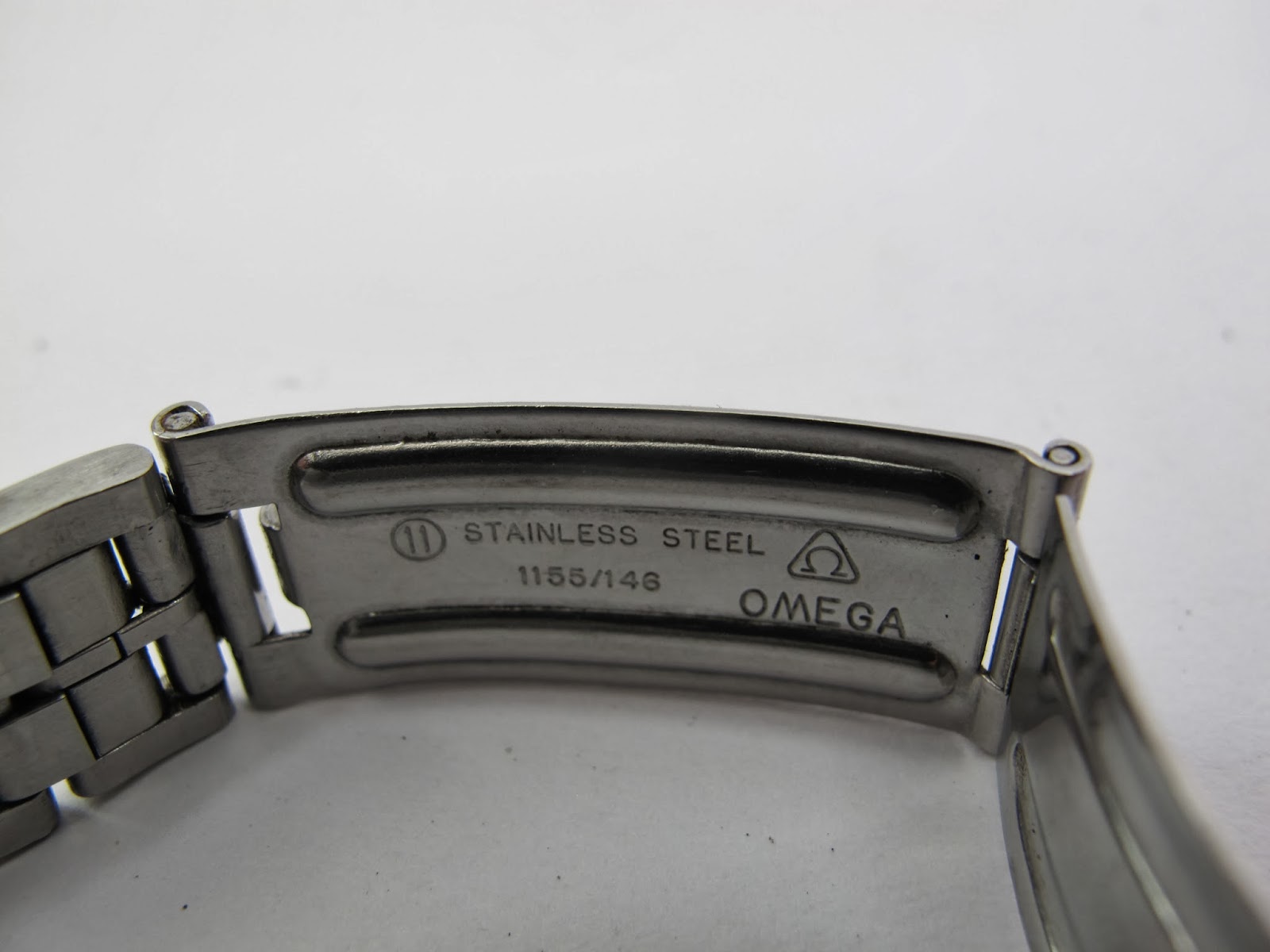
The factory stainless steel bracelet is still intact and in good condition. The folding clasp is proudly signed with a huge Omega logo. 


The inner clasp is also signed as well with a reference number of 1155/148. 


The screw-down backcase of the Constellations is nicely decorated with a space observatory station with 8 stars in the sky. 


The 1000 series was one of the best-selling of all Omega self-winding calibres. More than 1.5 million were used not only as certified chronometers in Constellations, but also the uncertified movements in Seamasters, Geneve and Speedmasters.


The certified chronometer calibre 1001 was the first of the series to power Constellations. Cal.1001 is a 20 Jewels automatic movement adjusted to 5 positions and temperature. It has a power reserve of 42 hours. Designed by Kurt Vogt under Alfred Rihs, it was an impressive 4.25mm thick. Apart from its high frequency (28,800bph), it incorporated a number of technologies, such as a hacking feature to allow more accurate time setting, instantaneous date and a thinner rotor to slow down and create less stress and wear on the winding mechanism. 


Despite its shortcomings, Cal. 1001 is of significant in Omega's horological history. The Omega Constellation Integral line does have its place in Omega's hall of fame and some may say hall of shame as well. 

(Acknowledgement: A good portion of this post is based on Desmond Guilfoyle's and http://omega-constellation-collectors.blogspot.com works.)